
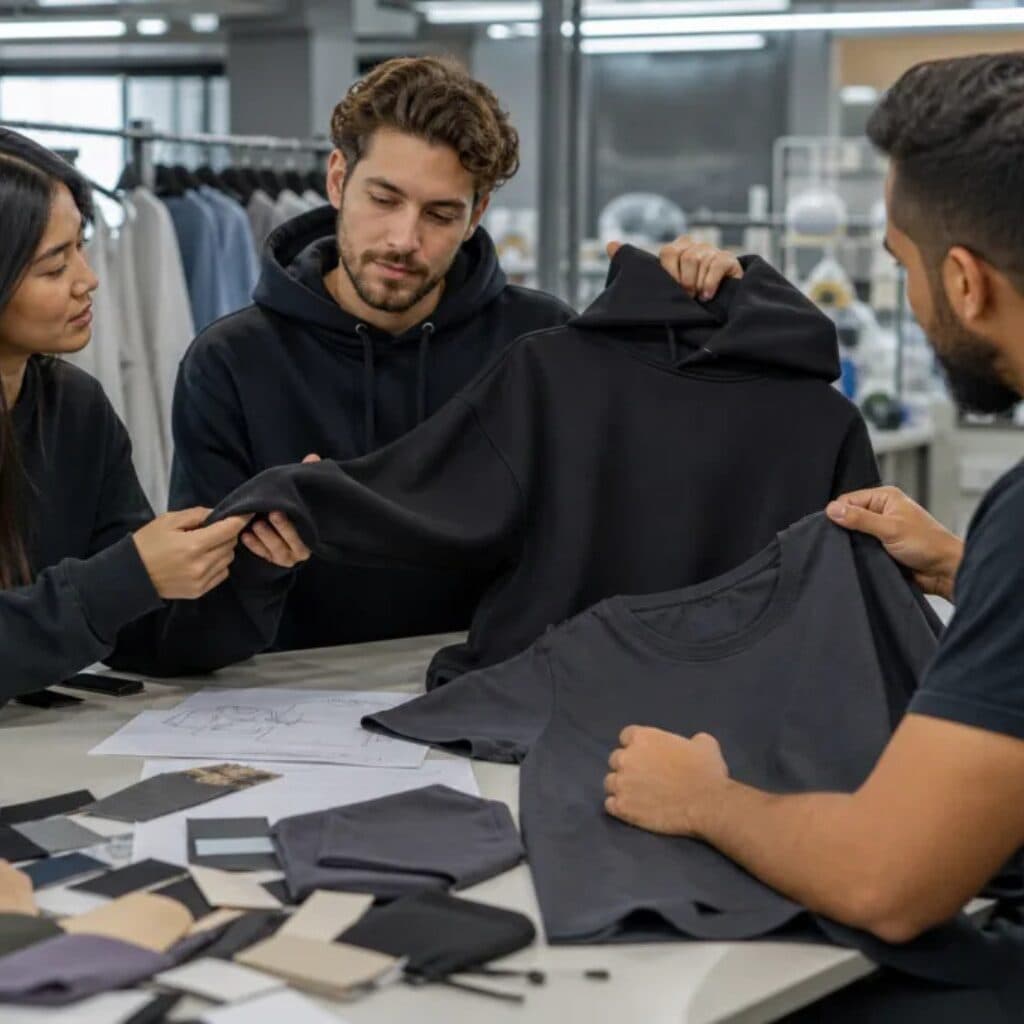
Before you search: what to prepare
Manufacturers answer clear requests first. Before you contact anyone, have these ready:
- What you want made: a tech pack for each style, or at least sketches and a reference garment.
- How many: the quantity per style and colour, split by size. This decides which manufacturers will take the order; see what MOQ means.
- Your target cost: work back from your retail price, as in our business plan guide.
- When you need it: count back from your launch date, leaving time for at least two sample rounds.
- Where you sell: your market decides the duty you pay and what the labels must say.
Know which kind of manufacturer you need
| Type | What they do | Best for |
|---|---|---|
| Cut and sew manufacturer | Makes garments from scratch to your pattern, fabric and spec | Your own fit, fabric and labels |
| Full-package manufacturer | Also handles patterns, fabric and trim sourcing, sampling and labels | Brands without a technical team |
| Blank supplier and decorator | Prints or embroiders on ready-made garments | Merch and fast, small runs |
| Print on demand | Prints each piece when it is ordered | Testing designs with no stock |
Domestic or overseas?
| Closer to home | Further away | |
|---|---|---|
| Price per piece | Usually higher | Often lower |
| Shipping and duty | Little or none | Freight, plus duty depending on the country |
| Visiting and communication | Easier, same time zone | Video calls; time differences |
| Made in label | Can carry your country's name | Shows the production country |
Duty depends on both ends: where the clothing is made and where you import it. Clothing from a country with a trade agreement can come in duty-free, while the same garment from elsewhere may pay 12% or more. Our guides for the US, the UK, Canada, Australia and New Zealand list the rates by production country.
Where to find clothing manufacturers
- Search engines. Search for the product and the service, such as "hoodie manufacturer low MOQ" or "cut and sew manufacturer", and look past the ads. A manufacturer's own site should show what it makes, its minimums and how to get a quote.
- Directories and sourcing platforms. Online directories list factories by product and country; in the US, Maker's Row lists domestic manufacturers.
- Trade shows. Large apparel shows such as MAGIC in Las Vegas (February 16–18, 2027) have sourcing areas where manufacturers exhibit, so you can see their work and meet them in person.
- Referrals. Ask other founders, designers, pattern makers and printers who they use. A recommendation from someone with a similar product is worth more than any listing.
How to check a manufacturer
Shortlist three to five manufacturers and ask each the same questions, so the answers are comparable. Our launch guide lists the questions to ask about minimums, samples, lead times and shipping terms. Then check:
- Relevant work. Ask for photos of garments like yours: the same category, fabric and construction.
- A paid sample. A manufacturer that makes a sample to your spec before you commit is showing you what bulk will look like.
- Certificates you can verify. Social audits such as amfori BSCI, WRAP or SA8000, OEKO-TEX STANDARD 100 for harmful substances, or GOTS for organic fibre. Ask for the certificate and check it on the certifier's site where it offers a lookup.
- Clear communication. Answers in writing, in a reasonable time, without vague promises.
- Written terms. A purchase order or contract that states the specification, quantities, price, delivery terms and what happens if the bulk does not match the approved sample.
Compare quotes on landed cost
The cheapest unit price is not always the cheapest garment. Check the shipping terms: under FOB (free on board), the price covers the goods loaded at the port of export, and you pay the freight, insurance and import duty. Under DDP (delivered duty paid), the seller delivers to your address with duty paid. Add everything up before you compare.
| Quote A (FOB) | Quote B (DDP) | |
|---|---|---|
| Unit price | $12.00 | $14.50 |
| Freight per piece | $1.40 | Included |
| Duty at 12% | $1.44 | Included |
| Landed cost per piece | $14.84 | $14.50 |
Sample first, then order
Approve a pre-production sample before you pay for bulk, and keep it as the reference that the bulk is checked against. The tech pack guide explains each sampling stage.
At Nevear, the minimum is typically 50 pieces per item and can grow to around 50,000 pieces in a single shipment. Samples take 2–3 weeks, and bulk orders usually arrive 3–4 weeks from the order date, shipping included. We work with partner factories in the US, the UK, Pakistan and China, and confirm the production country in your quote.