
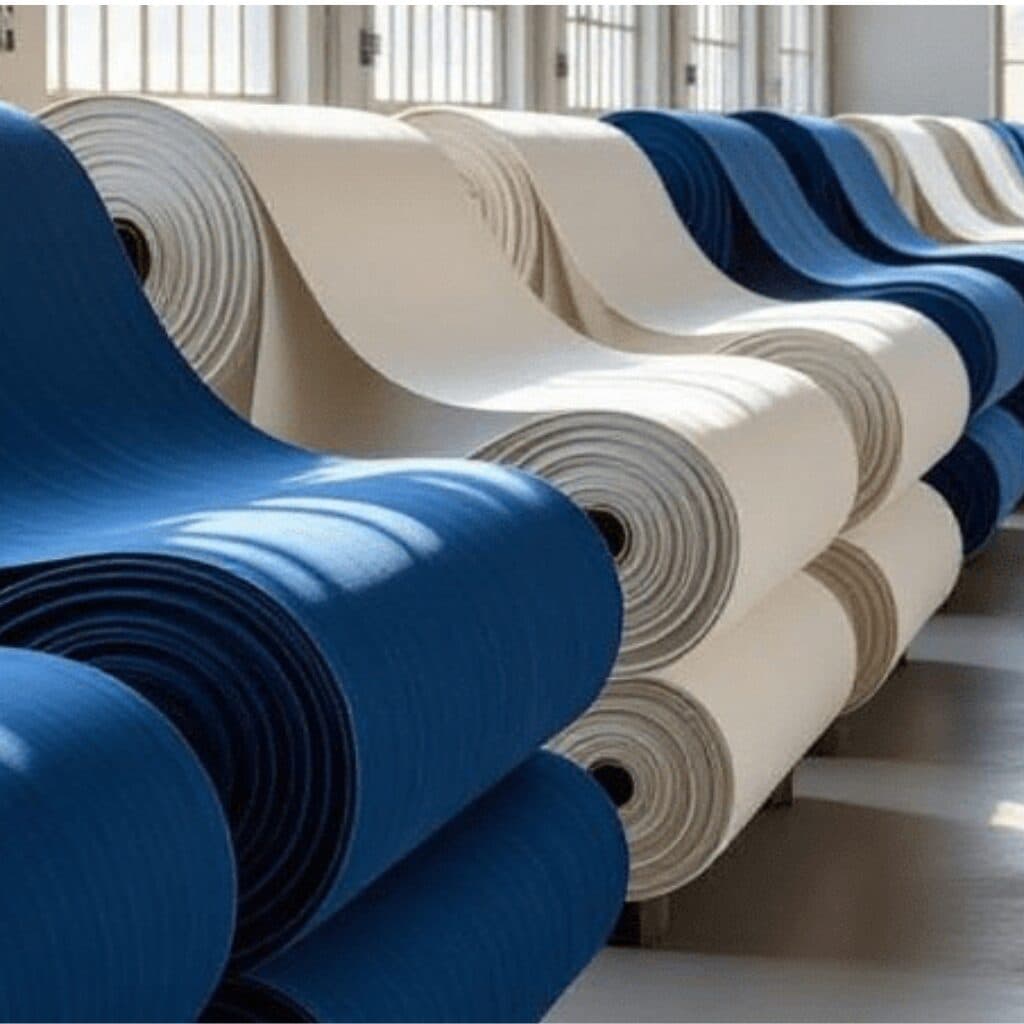
What does GSM mean?
GSM stands for grams per square metre. It is the weight of one square metre of fabric, and it is the standard way to describe how heavy a knit or woven fabric is. A 200 GSM jersey weighs 200 g per square metre; a 400 GSM fleece weighs twice as much.
The higher the GSM, the thicker, more opaque and usually warmer the fabric. GSM tells you nothing about the fibre, though: a 180 GSM cotton jersey and a 180 GSM polyester jersey feel very different. Our guide to cotton, polyester and blends covers the fibres; this one covers the weight.
How GSM is measured
How GSM is measured
1. Cut
A circular cutter takes a sample of exactly 100 cm² from the fabric.
2. Weigh
The sample goes on a precise scale. Here it weighs 2.00 g.
3. Multiply
A square metre holds 100 such samples, so multiply by 100.
Mills and test labs follow standard methods such as ASTM D3776, which sets out how to cut, weigh and calculate the mass per unit area of a fabric. Fabric takes up moisture from the air, so labs condition samples in a controlled atmosphere before weighing them, and they test several samples across the width of the roll rather than one.
That is why every fabric has a tolerance. Two rolls of the same "200 GSM" jersey will rarely weigh exactly 200 g per square metre each, so agree the acceptable range with your manufacturer before bulk production.
GSM and ounces: how to convert
In the US, fabric and blank garments are often described in ounces per square yard. One ounce is 28.35 g and one square yard is 0.836 m², so 1 oz/yd² is 33.9 GSM. Multiply ounces by 33.9 to get GSM, or divide GSM by 33.9 to get ounces.
| oz/yd² | GSM | Typical use |
|---|---|---|
| 4 oz | 136 | Light tees and tanks |
| 5 oz | 170 | Everyday t-shirts |
| 6 oz | 203 | Midweight t-shirts |
| 8 oz | 271 | Heavyweight tees, light sweatshirts |
| 10 oz | 339 | Midweight hoodies and joggers |
| 12 oz | 407 | Heavyweight hoodies; midweight denim |
| 14 oz | 475 | Heavy denim and fleece |
Denim is almost always sold in ounces: 12 to 14 oz denim is about 405 to 475 GSM. One catch: some fabric suppliers quote ounces per linear yard of a roll of a given width rather than per square yard, which gives a different number. Ask which one a quote uses.
What GSM to choose for each garment
Typical fabric weight by garment (GSM)
| Garment and fabric | Typical GSM | What it feels like |
|---|---|---|
| T-shirt: tri-blend or performance jersey | 130–180 | Light, drapey or quick-drying |
| T-shirt: combed ring-spun cotton | 160–220 | The everyday printed brand tee |
| T-shirt: heavyweight cotton jersey | 220–300 | Structured and opaque, for boxy streetwear fits |
| Leggings: nylon or polyester with elastane | From about 220 for coverage | Denser fabric is less likely to turn see-through |
| Joggers: French terry | 240–350 | Smooth outside, looped inside; cooler than fleece |
| Hoodie: French terry | 280–400 | Breathable and holds its shape, for all seasons |
| Hoodie: brushed fleece | 300–450 | Soft pile inside; warmer and cosier |
| Hoodie: heavyweight terry or fleece | 400–500+ | Dense and structured, for premium streetwear |
Is a higher GSM better?
Not on its own. GSM measures weight, not quality. A 180 GSM tee in combed ring-spun cotton can feel smoother and last better than a 220 GSM tee knitted from coarse open-end yarn. The yarn, the knit density and the finishing matter as much as the weight.
Choose the weight for the job. Heavier fabric gives structure, opacity and warmth, which is why streetwear brands favour 240 GSM tees and 400 GSM hoodies. Lighter fabric drapes, breathes and dries faster, which suits summer tees, activewear and layering pieces. Heavier fabric also costs more per garment, because you are buying more fabric.
How to specify GSM in a tech pack
- Write the fabric in full: composition, construction and weight, for example "100% combed ring-spun cotton jersey, 200 GSM".
- Agree a tolerance, such as plus or minus 5%, so you know what counts as on spec.
- Say when it is measured. Washing and garment dyeing change the weight, so agree whether the GSM is for the fabric before or after the wash.
- Approve it on the sample. Feel the fabric of the approved sample, keep it as the reference, and compare the bulk against it.
Our tech pack guide includes a free template with a place for each of these. At Nevear the minimum is typically 50 pieces per item, samples take 2–3 weeks, and bulk orders usually arrive 3–4 weeks from the order date, shipping included.