
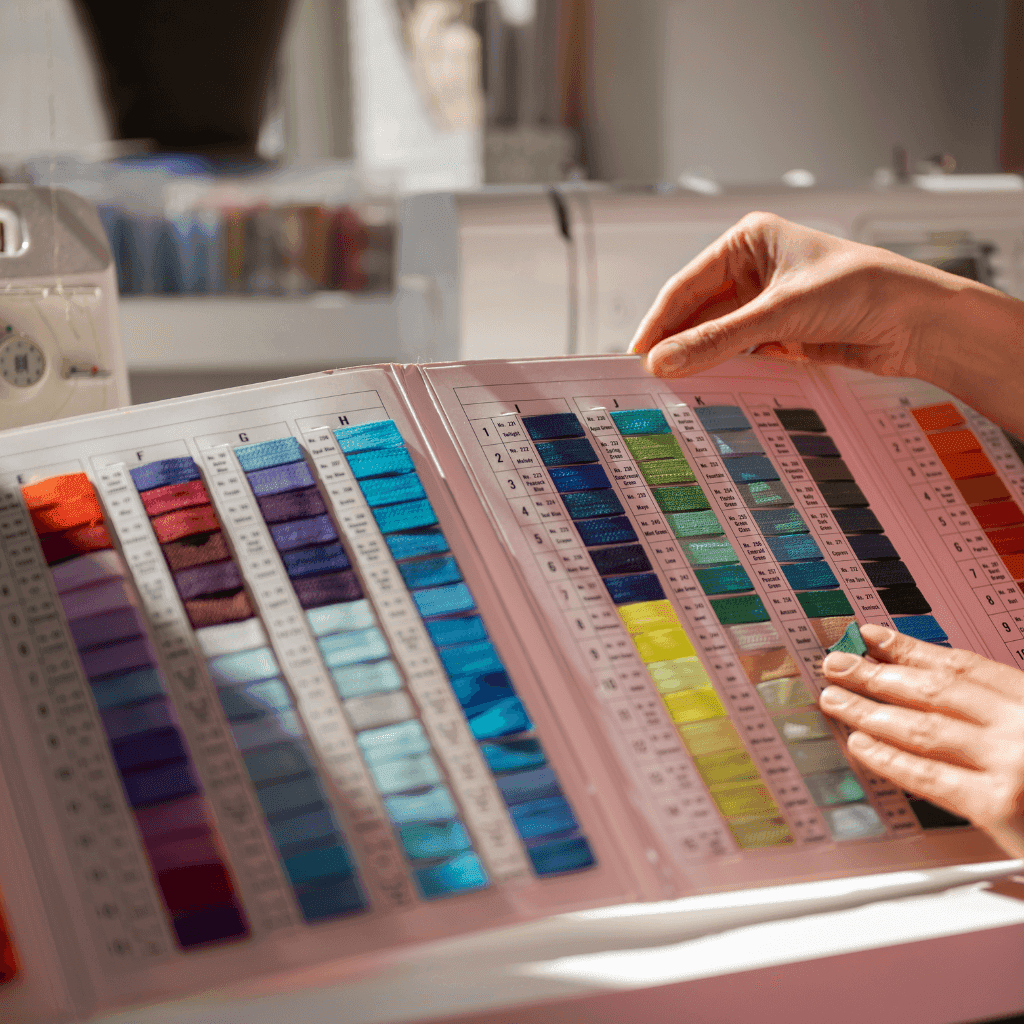
How embroidery works
Embroidery starts with digitizing: the artwork is turned into a stitch file that tells the machine where every stitch goes, in what order and in which colour. Digitizing is a one-off setup cost per design. The garment is then hooped tightly over a backing, called a stabilizer, and a multi-needle machine sews the design, switching thread colours automatically.
The three basic embroidery stitches
Running stitch
A single line of stitches for outlines and fine detail.
Satin stitch
Long, tight stitches side by side, for lettering and borders. Shiny, but limited in width.
Fill stitch
Rows of short stitches in an offset pattern, to cover large areas.
Because the design is made of thread, it has texture and a slight sheen, it does not crack or peel, and the colours are fixed by the thread you choose rather than mixed like ink.
How screen printing works
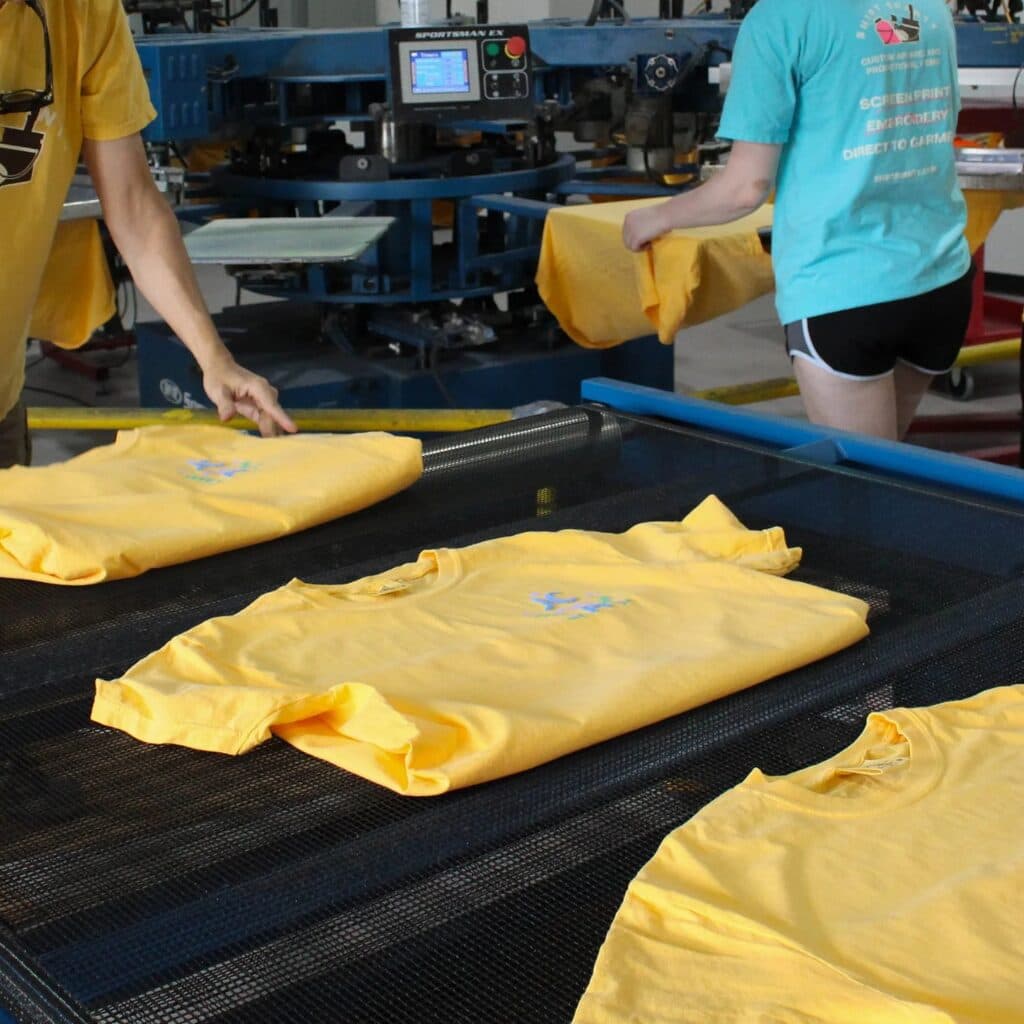
Screen printing separates the design into its colours and makes a screen, a fine mesh stencil, for each one. Ink is pushed through each screen onto the garment and cured with heat. The screens are the expensive part; after that, each print is quick. Our screen printing vs DTG guide explains it in detail.
What drives the price
| Embroidery | Screen printing | |
|---|---|---|
| One-off setup | Digitizing the design | A screen for each colour |
| Main cost per piece | Stitch count: the size and density of the design | Number of colours and print locations |
| Adding a colour | Little or no extra cost | Another screen and another pass |
| Making the design bigger | More stitches, more machine time: cost rises quickly | Costs little more in the same colours |
| Ordering more pieces | Price per piece falls slowly | Price per piece falls quickly as setup spreads out |
So a small embroidered chest logo in five colours can cost less than a five-colour screen print on a short run, while a full-back design is almost always cheaper to print. Quantities matter too: the MOQ guide explains how setup costs spread across an order.
Embroidery vs screen printing side by side
| Embroidery | Screen printing | |
|---|---|---|
| Look and feel | Raised, textured thread with a slight sheen | Flat ink; soft with water-based ink, thicker with plastisol |
| Fine detail | Limited: very small text and thin lines fill in | Fine lines, small text and halftones |
| Gradients and photos | No: solid thread colours only | Yes, with halftones |
| Best design size | Small to medium: chest, sleeve, cap front | Any size, up to a full back print |
| Best fabrics | Stable and heavier: fleece, piqué, twill, caps | Most fabrics, with the right ink |
| Durability | Very durable; does not crack or fade like ink | Durable when cured properly |
| Special effects | 3D puff embroidery, metallic thread | Puff, metallic and high-density inks |
Which garments suit which method
- Caps and hats: embroidery. It holds up on the structured front panel, and 3D puff embroidery gives a raised logo. See our hats.
- Polos and workwear: embroidery, usually a small logo on the chest.
- [Hoodies](/hoodies/) and sweatshirts: both. A common combination is an embroidered chest logo with a large screen print on the back.
- [T-shirts](/t-shirts/): mostly screen printing. Embroidery works for small designs on midweight or heavier jersey, but dense stitching on a thin tee can pucker and feel stiff inside.
- [Jackets](/jackets/): embroidery or patches.
- Performance fabrics: screen printing with suitable ink, or heat transfers; dense embroidery can pull stretchy fabric out of shape.
Patches: embroidery without the stitch count
Patches are made separately and then sewn or heat-applied to the garment. Embroidered, woven and chenille patches give an embroidered look on large designs or thin fabrics where direct embroidery would be too dense or too heavy, and chenille letters are the classic varsity-jacket finish.
For a raised logo, you can also compare 3D puff embroidery with puff print, which gives a similar lift with ink.
Which should you choose?
- A small logo on caps, polos, hoodies or jackets: embroidery.
- A large design, or many colours on a short run: screen printing.
- Gradients, photos or fine detail: screen printing with halftones, or DTG on cotton.
- A premium look on a lightweight garment: a patch, or a small embroidered logo with a backing.
At Nevear the minimum is typically 50 pieces per item, and we confirm the decoration method that suits your design, garment and quantity in your quote. Samples take 2–3 weeks, and bulk orders usually arrive 3–4 weeks from the order date, shipping included.